
I had the privilege of participating in two discussions marking the 25-year anniversary of the U.S. Department of Energy's Scientific Discovery through Advanced Computing program, better known as SciDAC. I returned in a new role, after years at Argonne and Oak Ridge and now as co-founder and CEO of PrimaLabs, which made the experience especially meaningful.
Across a roundtable on SciDAC's next decade and a panel on successful industry collaborations, we explored how AI, quantum computing, and a changing research landscape are reshaping scientific discovery, and how stronger partnerships can turn emerging innovations into sustained capabilities. Together, the discussions addressed a fundamental question: how should SciDAC evolve so that advances in computing translate into trustworthy scientific discovery and durable real-world impact?
My experience across national laboratories and industry has convinced me that SciDAC already offers a strong model for meeting that challenge.
SciDAC as Forward-Deployed Engineering
for Scientific Discovery
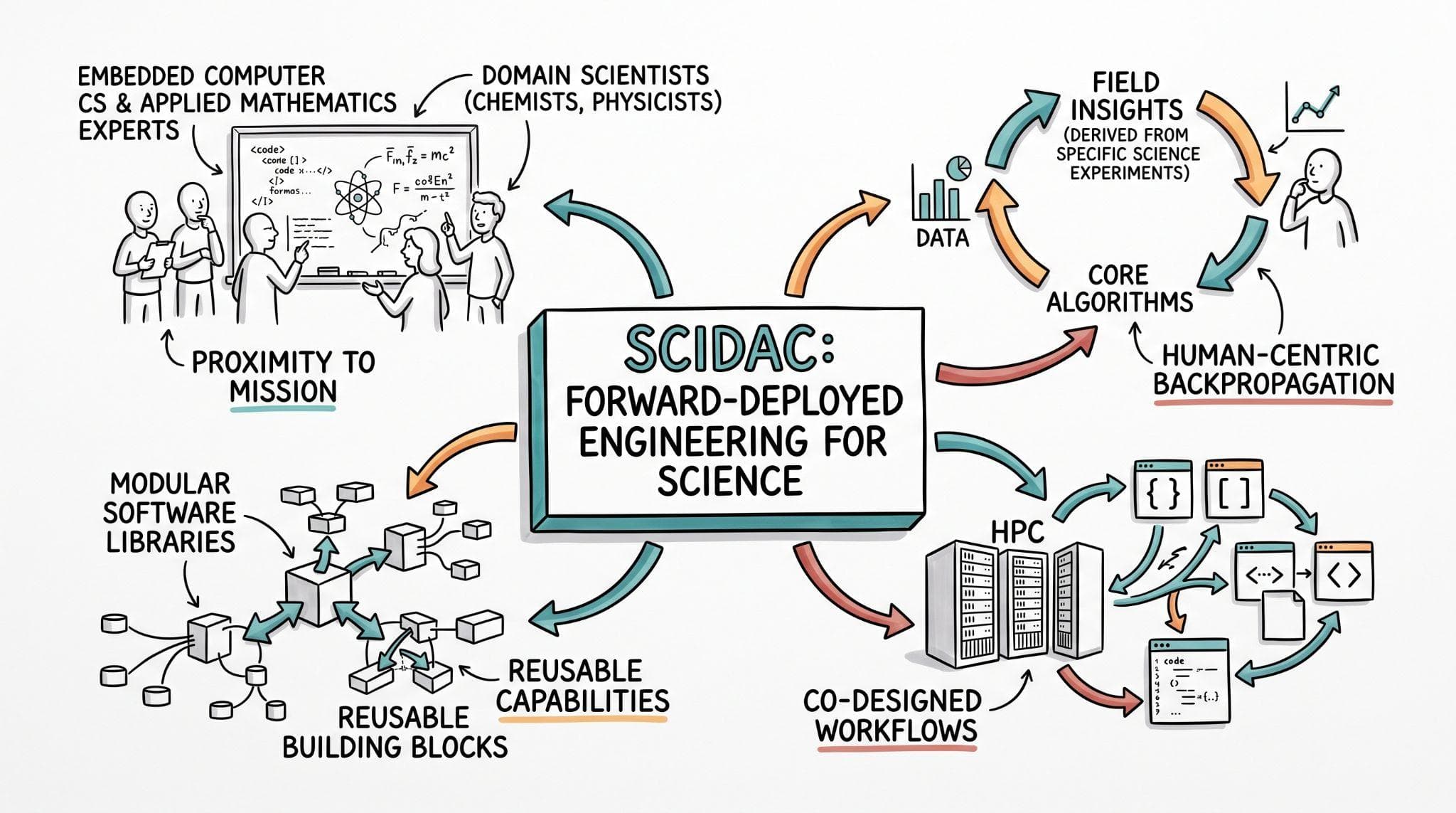
One idea stayed with me through both discussions. Long before "forward-deployed engineering" became a popular term in Silicon Valley this year, SciDAC had been practicing its scientific equivalent. Forward-deployed engineering places deeply technical people close to consequential real-world problems. They work alongside users, understand the domain, adapt the system, and turn what they learn into reusable capability. Palantir mastered this operating model by making proximity to the mission part of its product-development system. Its forward-deployed engineers work directly with customers on demanding operational problems and carry what they learn back to the core engineering organization. Palantir describes this feedback loop as the human equivalent of backpropagation: field experience continuously shapes the platform.
The wider AI industry is now placing multibillion-dollar bets on the same model. In 2026, OpenAI launched its Deployment Company with more than $4 billion in initial investment, AWS committed $1 billion to embed engineers with customers, and Microsoft announced a $2.5 billion deployment organization bringing together 6,000 engineering and industry experts. The bet behind all three is that enterprise AI value comes from deep integration with customer data, workflows, infrastructure, governance, and operations.
For 25 years, SciDAC has operated this way. It brings applied mathematicians, computer scientists, software engineers, and domain scientists together around specific DOE science missions. Teams work closely enough to understand both the scientific question and the computational bottleneck. They co-design algorithms, software, models, and workflows for real scientific applications, then carry the resulting advances into broader tools and communities.
At PrimaLabs, we apply the same principle to performance engineering for AI systems. The most useful infrastructure work begins with the real workload, the scientific or business objective, and the operational constraints. Getting a model to run is the starting point; the work is making it reliable, efficient, and useful in production.
From Scaling Computation to Scaling Discovery
Over its first 25 years, SciDAC helped the scientific community move from terascale to petascale and ultimately to exascale computing. As AI reshapes how researchers form hypotheses, run experiments, analyze results, and make decisions, the opportunity for SciDAC Phase 6 is to scale the entire discovery process.
I see three shifts: First, we must move from individual simulations toward integrated discovery loops connecting AI models, experimental facilities, scientific instruments, data systems, and human judgment. AI should help generate hypotheses, guide experiments, identify uncertainty, and determine what computation or measurement should happen next. Second, we must expand our definition of performance. Scientific productivity includes FLOPS and scaling efficiency alongside time to trustworthy insight, reproducibility, energy efficiency, and adoption. Third, we must build sustained capabilities. Models, software, datasets, benchmarks, and workflow systems should support continued maintenance, improvement, and reuse across projects and funding cycles.
By 2036, the goal should be AI-enabled science that generates falsifiable hypotheses, closes the loop between theory, modeling, simulation, and experiment, and produces trustworthy discoveries that are out of reach today.
Trustworthy AI Requires Stronger Foundations
The rise of AI increases the value of strong foundations in applied mathematics, computer science, and domain science. Scientific AI must operate differently from systems where plausibility is enough. We need verification, uncertainty quantification, provenance, reproducibility, and connections to physical principles. Benchmarks must represent realistic scientific workflows, and models must reveal when they are extrapolating or uncertain.
SciDAC already connects applied mathematicians, computer scientists, domain scientists, facilities, and advanced computing resources. The next phase should deepen those connections and bring experimental science, AI engineering, and industry expertise into them earlier.
For early-career researchers, my advice is to build durable foundations. Develop depth in mathematics, algorithms, systems, or a scientific domain, and learn to use AI as an instrument within that foundation. The researchers who will have the greatest impact are those who can connect new AI capabilities to rigorous scientific questions.
The national laboratories offer mission, unique facilities, extraordinary data, and the opportunity to work on nationally important problems. Retaining outstanding talent requires pairing that mission with autonomy, modern tools, rapid access to resources, and clearer paths from research into use.
Industry Partnerships Require Clear Roles
The industry collaboration panel turned from the future of the program to the mechanics of partnership. The phrase "industry partner" can hide important differences. A hardware company, a scientific software firm, an industrial end user, and a seed-stage startup work on different timelines, face different incentives, and contribute different capabilities. Industry can serve as a research partner, technology provider, productization partner, end user, or scale partner. One company may co-develop algorithms, another may contribute hardware and performance engineering, and a third may turn a prototype into a secure, supported service. Effective partnerships assign each participant a clear and differentiated responsibility. That responsibility should be established early. What is the mission problem? What does each organization uniquely contribute? Who owns deployment and continued operation? How will success be measured? Vague answers lead to activity that stalls before sustained impact.
Production Reality Strengthens Research
Scientific research often begins by asking whether a method works. Industry introduces another set of questions: can it work reliably, securely, economically, and repeatedly for real users?
These operational demands often expose new research problems.
A method that performs well in a controlled benchmark may behave differently under real workloads, failures, security constraints, or changing demand. A promising model may still be unusable if its cost, latency, energy consumption, or operational burden is too high.
Industry contributes production discipline, rapid iteration, specialized engineering, customer feedback, and operational accountability. It brings attention to observability, testing, privacy, total cost, and sustained ownership.
Early research needs freedom to explore. Once a project targets operational or scientific impact, its research plan should include deployment, ownership, and sustained operation.
The Clocks Move at Different Speeds
One of the hardest challenges is the mismatch in time and incentives.
A startup may have 12 to 18 months of runway, while contracting, procurement, security reviews, and approvals can consume a significant portion of that period. If it takes a year to establish a six-month collaboration, the mechanism effectively excludes the companies that move fastest.
Researchers are rewarded for novelty, publications, and reusable knowledge. Companies must also consider adoption, support, operational responsibility, and sustainability. DOE values openness, while a company may need a viable intellectual-property position to justify continued investment.
Early alignment can reconcile these interests and prevent late-stage friction.
Strong collaborations define intellectual-property, data, and publication rights at the beginning. They agree on measurable milestones before technical work starts. They identify who will deploy, operate, and maintain the resulting capability. They also use phased agreements so that a focused initial project can expand quickly when it demonstrates value.
A Stronger Path from Research to Sustained
National Capability
SciDAC has been highly effective at supporting discovery and demonstration. The next challenge is to make the path from successful prototype to sustained capability more deliberate.
Who owns the result after the award ends? Who funds reliability, deployment, and user support? Should the capability remain an open project, become a laboratory service, or be sustained by an external organization?
DOE laboratories and universities contribute scientific depth, mission knowledge, facilities, data, and long-term ambition. Industry contributes speed, production experience, specialized talent, and paths to wider adoption. Strong programs combine these strengths intentionally.
One practical step would be a startup-friendly industry translation pathway in the broader SciDAC ecosystem. Placing it there lets SciDAC keep its focus on scientific research, while partnership projects handle integration, productization, and deployment. The pathway could include shorter milestone-based agreements, standard intellectual-property and data-rights templates, small paid evaluations before larger commitments, and access to representative scientific workloads. It should also keep a direct line back to SciDAC teams, so that what partners learn in deployment shapes the next round of research, the same loop that makes forward-deployed engineering work.
Measures of success should include publications, benchmark results, time to deployment, scientific adoption, reproducibility, operational reliability, cost reduction, energy efficiency, and sustained use after the initial funding period.
Looking Ahead
The next phase should give early-career researchers room to pursue difficult mission-driven work and create faster pathways for industry, including startups, to turn research into capabilities scientists can depend on.
DOE brings mission and scientific depth. Universities bring foundational ideas and new researchers. Established companies bring platforms and scale. Startups bring speed, focus, and a willingness to build around emerging capabilities. Bringing these strengths together early can change the scientific outcome.
That is the opportunity I took away from both panels, and the kind of partnership I hope we continue to build through SciDAC over its next decade.
My thanks to Xujing Davis, Rob Ross, and Hal Finkel for inviting me to participate in the SciDAC 25-Year Anniversary panels.
Key Takeaways
- SciDAC's 25-year history demonstrates the value of bringing scientific expertise, advanced computing and engineering teams together around real-world research problems. As AI becomes increasingly embedded in scientific workflows, the next opportunity is to extend this model toward integrated, trustworthy and production-ready AI-enabled discovery.
Frequently Asked Questions
What is SciDAC?
What is forward-deployed engineering for science?
How has SciDAC supported scientific discovery?
How can AI change scientific discovery?
What does trustworthy scientific AI require?
Why are production requirements important for scientific AI?
What role can industry play in scientific research?
What challenges can startups face when working with research institutions?
How can research and industry collaborations become more effective?
What does a stronger path from research to sustained capability look like?
About the Author
Prasanna Balaprakash is co-founder and CEO of PrimaLabs, which runs the fastest inference for open models, ranked #1 on Artificial Analysis for DeepSeek V4 Flash and MiMo-V2.6-Pro. Before PrimaLabs, he was Director of AI Programs at Oak Ridge National Laboratory. There he led 50+ researchers, including the first trillion-parameter model training on Frontier and the 113B-parameter ORBIT climate foundation model, a two-time Gordon Bell Prize finalist. Earlier he led research at Argonne National Laboratory, where he co-created the open-source tools DeepHyper and ytopt. He holds a PhD in AI from the Université Libre de Bruxelles.
Disclaimer: The views and opinions expressed in this article are my own and do not necessarily reflect the views of the U.S. Department of Energy, the Office of Advanced Scientific Computing Research, or the U.S. Government.