
The fastest DeepSeek
V4 Flash endpoint
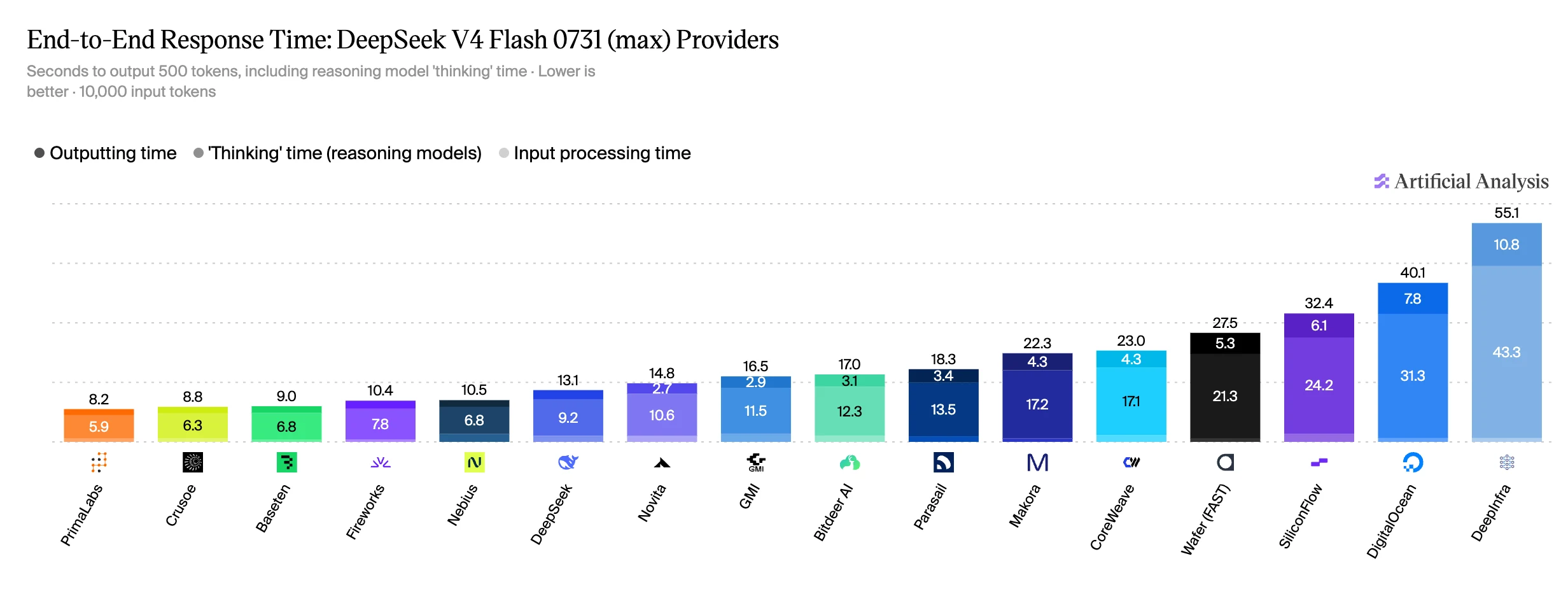
Artificial Analysis benchmarked the leading providers serving DeepSeek V4 Flash 0731 on the same harness. Across the 15 providers measured alongside us, PrimaLabs finished first on output speed, end-to-end response time and time to first answer token, at $0.06 per million tokens blended — among the lowest prices in the field.
PrimaLabs is building the adaptive operating system for AI inference, powered by a workload-aware runtime that continuously operates each application's inference stack. It translates application objectives into execution policy, coordinates models and GPU resources across the stack, enforces quality, reliability and isolation boundaries, and learns from production behavior over time. The DeepSeek result is the first independent proof point for that system.
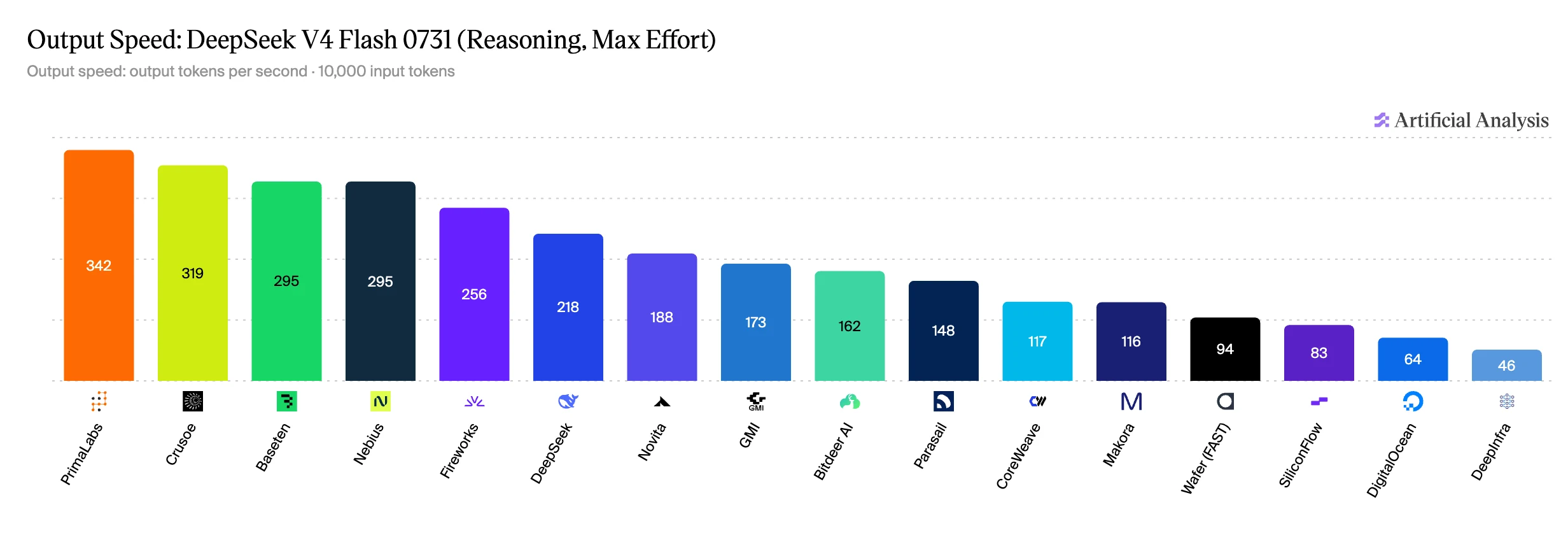
DeepSeek V4 Flash 0731 is the first endpoint we have put through independent benchmarking. Artificial Analysis measured it against 15 other providers of the same model. PrimaLabs came first on output speed, end-to-end response time and time to first answer token, at $0.06 per million tokens blended, near the bottom of the measured price range. DeepInfra is cheaper at $0.04 per million tokens; it is also the slowest endpoint measured, at 46 t/s.
Every vendor claims to be fast, and self-reported benchmarks deserve scepticism, ours included. The vendor picks the prompt mix, the tokeniser, and which runs make the chart. A third-party harness takes those choices away from us and applies the same methodology to everyone, in the open. None of the figures below are ours. They are from Artificial Analysis, measured on repeated runs and reported as a median, and you can check every one of them against the public leaderboard.
A general-purpose serving stack is built to behave reasonably across many models and traffic patterns. That is a useful baseline, but it leaves application-specific performance on the table. Coding agents, voice systems, document pipelines and scientific models place different pressure on prefill, decode, memory, caching and the scheduler. The best stack is therefore not a universal preset. It is a workload-dependent operating point that must be discovered, measured and updated.
The full result set
Four measures, sixteen providers, one harness. Every figure below is from the same Artificial Analysis snapshot of DeepSeek V4 Flash 0731 (Reasoning, Max Effort), measured on repeated runs and reported as a median. Where a comparison is named, it is the best result any other provider posted on that measure — in our favour on the first three, against us on price.
Output speed
Tokens per second on Artificial Analysis’s default 10,000-token workload. The highest of the sixteen endpoints measured, on the same model, reasoning effort and input profile as everyone else in the field.
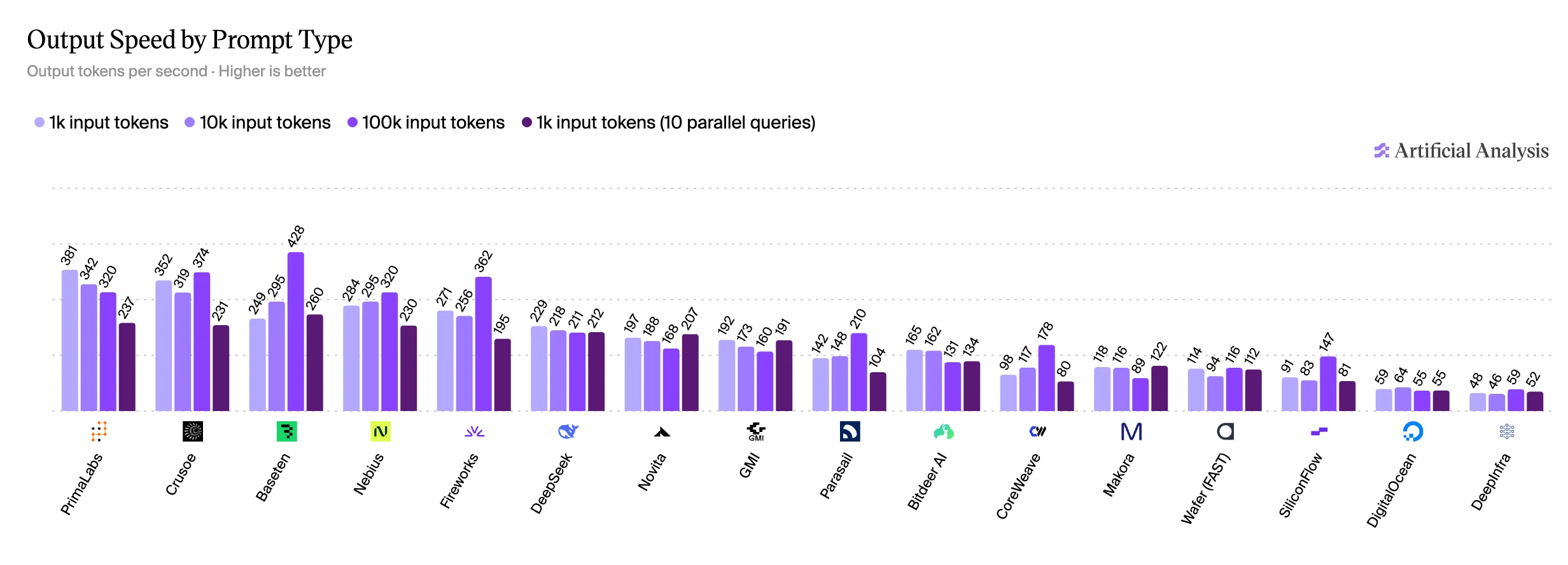
Output speed across context lengths
The lead is not an artefact of one prompt size. Output speed was measured at 1K, 10K and 100K input tokens, and PrimaLabs is first at 1K and at 10K.
End-to-end response time
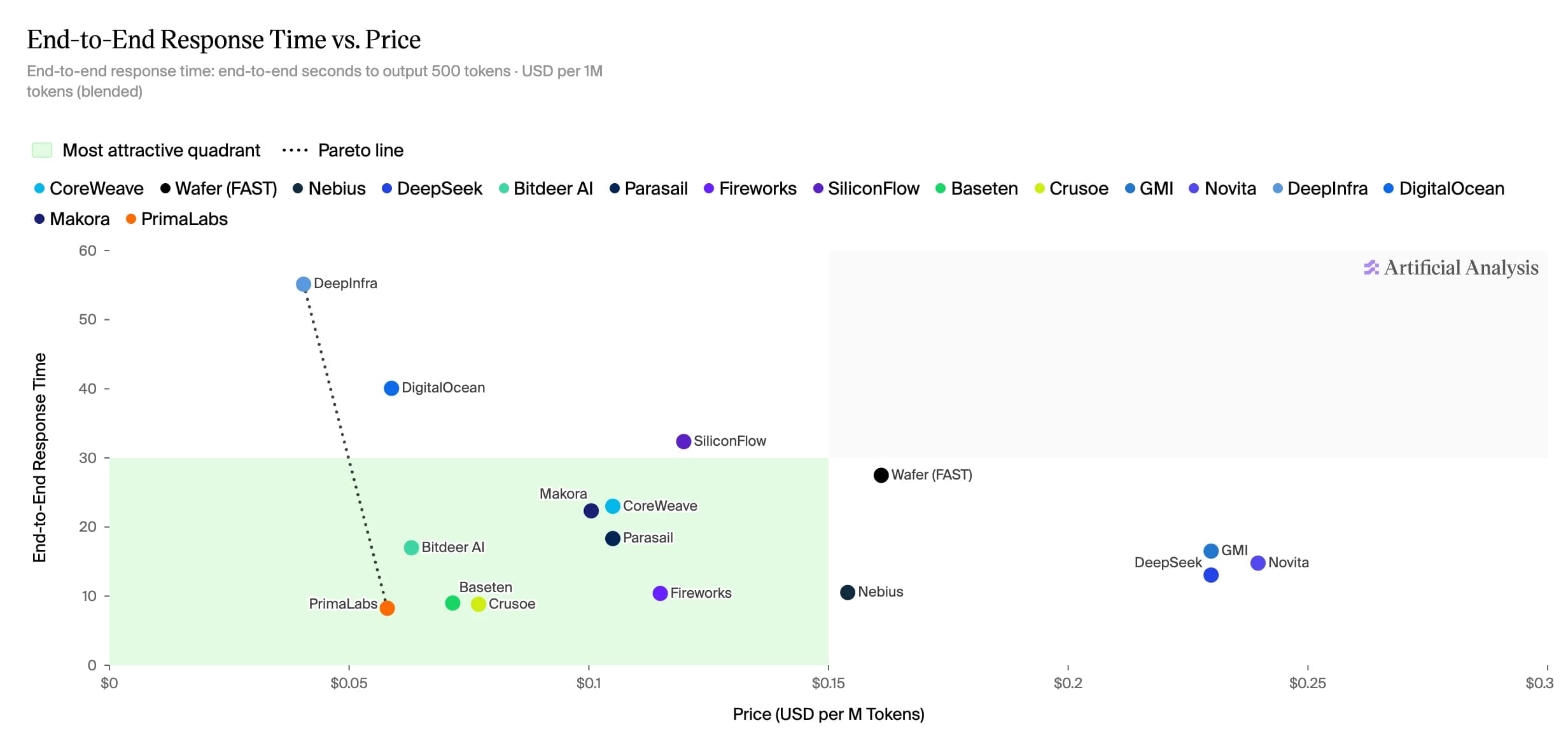
Seconds to return 500 output tokens, reasoning included. This is the number an application actually waits for.
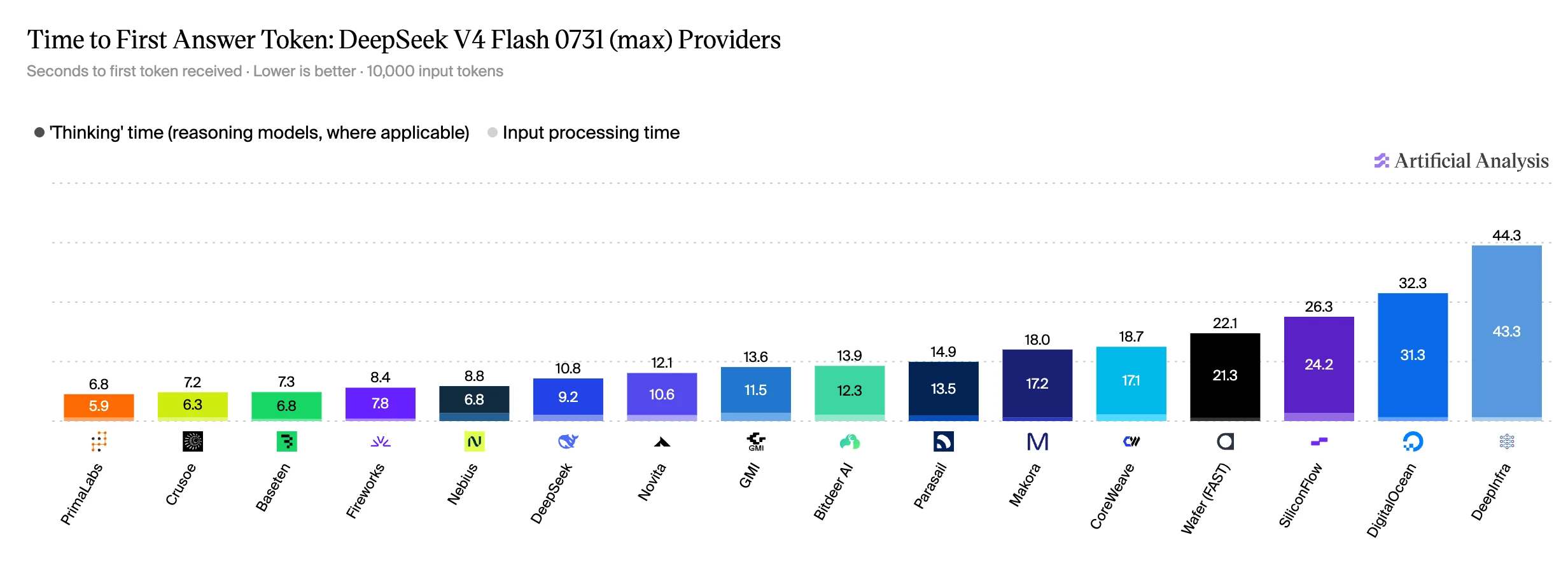
Time to first answer token
Seconds until the answer begins, after the reasoning pass. On a reasoning model this is the perceived latency of the product built on top of it.
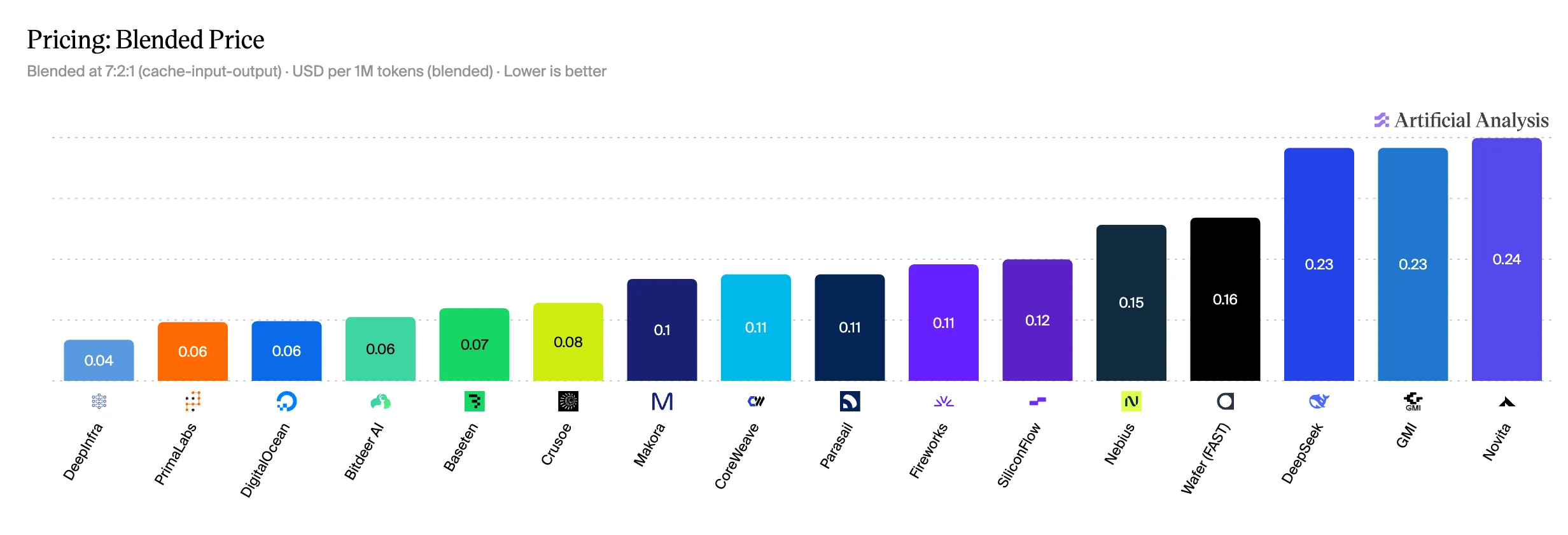
Blended price
USD per million tokens at a 7:2:1 input/output/cache blend. This is the one measure of the four that is not ours, and it is here on the same terms as the rest. PrimaLabs is tied at $0.06 with DigitalOcean and Bitdeer AI; only DeepInfra is cheaper, at $0.04, and it is also the slowest endpoint measured, at 46 t/s against our 342.
The three measures against each other
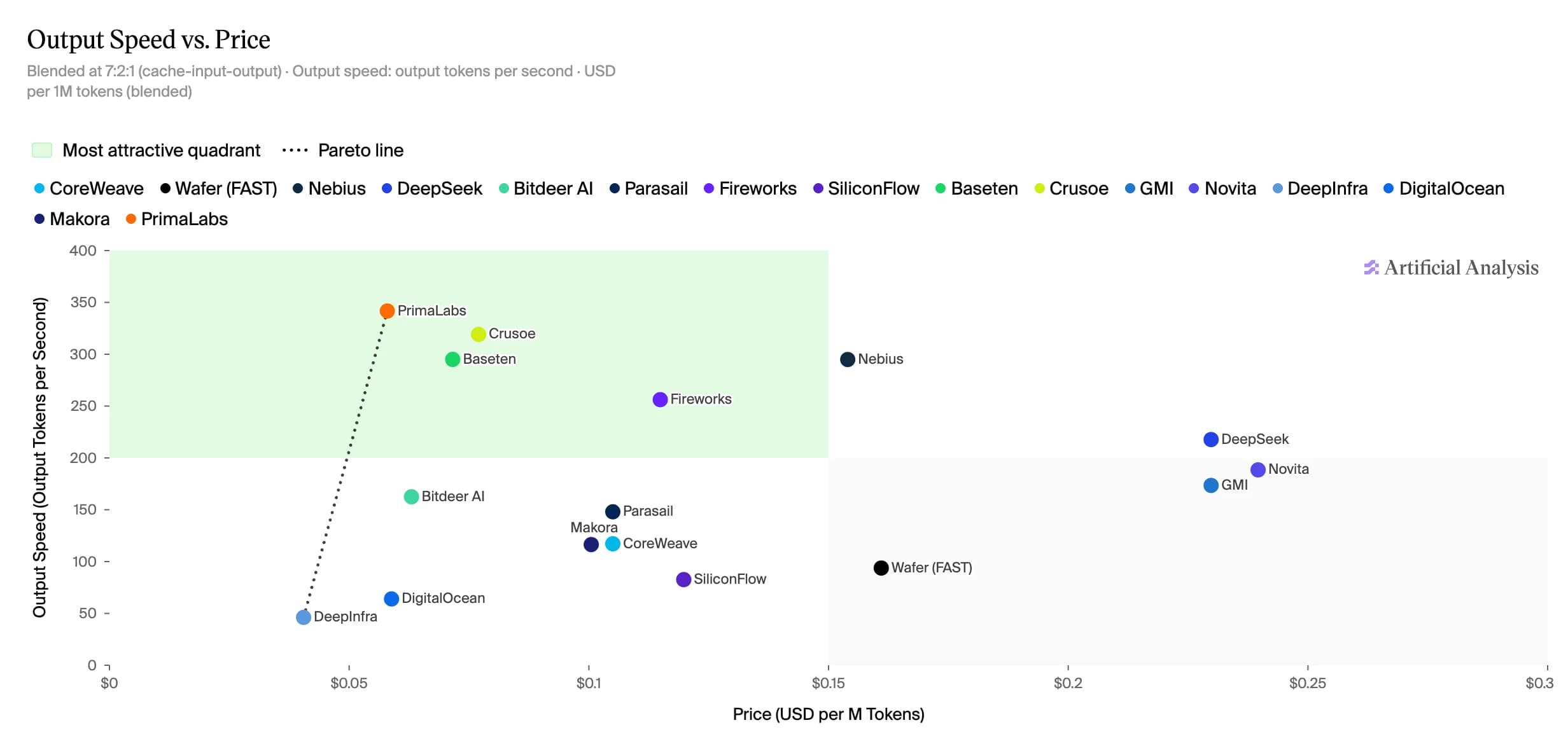
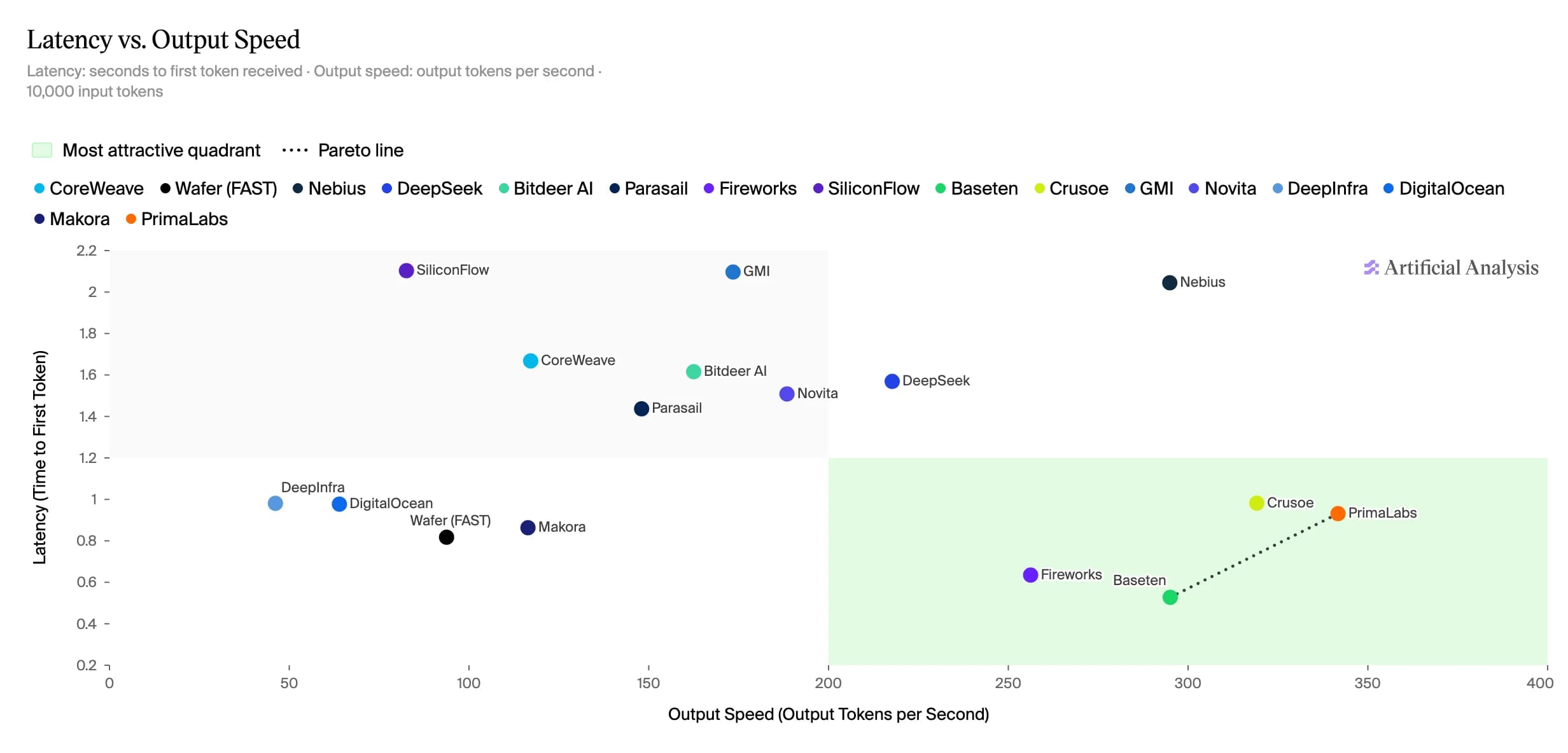
Speed, latency and price are the same measurement seen from one axis each. Plotted against one another, the efficient frontier for this model is short, and PrimaLabs sits on the useful end of all three.
Fastest in the field, at the low end of the price range
Speed usually costs money. On this benchmark it did not. PrimaLabs returned the highest output speed of the sixteen providers measured and did so at $0.06 per million tokens blended, at the low end of the range Artificial Analysis recorded for the model. DeepInfra prices the model lower at $0.04 per million tokens, and returns 46 t/s against our 342.
That combination is the operating point the runtime is tuned for: throughput per GPU, not throughput per dollar spent on more GPUs. The same hardware class, serving the same model, with the execution path optimized end to end.
Highest of the sixteen endpoints measured on DeepSeek V4 Flash 0731.
Same model, reasoning effort, input profile and harness.
Second lowest of sixteen, tied with DigitalOcean and Bitdeer AI. Only DeepInfra is cheaper, at $0.04.
Fastest measured; 0.4 s ahead of Crusoe at 7.2 s.
For this endpoint, PrimaLabs used continuous batching, chunked prefill and a workload-tuned admission policy. Artificial Analysis independently measured the resulting endpoint behavior; it did not isolate the contribution of each mechanism.
The technical foundation of the adaptive operating system
PrimaLabs learns the joint performance surface of an application and its inference stack, then improves end-to-end execution across coupled software and hardware layers. Three capabilities make that possible.
Measure the scenarios that matter
Controlled experiments span context length, concurrency, cache reuse, service objectives, model configuration and hardware state. Each run expands a performance corpus that captures interactions across the stack. Measurements remain inside the deployment boundary and do not require raw prompts or responses to leave the customer environment.
Optimize the application path
The runtime coordinates KV-cache placement, memory hierarchy, prefill and decode behavior, batching, parallelism, interconnect traffic and GPU topology. An isolated kernel can be faster while the application remains slower; PrimaLabs optimizes the complete execution path.
Learn from every experiment
A scalable, mathematically grounded, constrained multi-objective zeroth-order optimizer selects experiments and learns the performance surface directly from measured outcomes, without requiring gradients. Its asynchronous architecture can coordinate evaluation from a single node to thousands of parallel GPU workers, allowing system optimization to scale with the available fleet. AI models can propose implementation candidates; the optimization engine decides what to evaluate and governs constraints and promotion.
PrimaLabs did not begin with this endpoint. Its technical foundation draws on more than a decade of our research in automatic performance tuning, scalable black-box optimization and AI systems engineering. Autotuning in High-Performance Computing Applications established performance engineering as structured search across implementation spaces. ytopt extended this approach to performance and energy optimization across millions of possible configurations. DeepHyper demonstrated asynchronous, decentralized optimization across 1,920 parallel workers on the Polaris supercomputer while maintaining more than 95% worker utilization. ORBIT showed that model architecture, parallelism, data movement and hardware topology must be engineered together. PrimaLabs brings these ideas into an adaptive operating system for production AI inference.
The runtime closes the loop
No single optimization produced the benchmark result. The workload-aware runtime executes five connected stages.
Observe
Characterize workload behavior using privacy-preserving telemetry collected inside the deployment boundary: aggregate token counts, concurrency, cacheability, service objectives and customer-defined quality gates. Raw prompts and responses are not required by PrimaLabs.
Search
Use constrained zeroth-order optimization to explore coordinated choices across model format, data movement, kernels, cache, scheduling, parallelism and GPU topology.
Validate
Accept a faster stack only when it passes workload-specific accuracy, reliability and service-level gates.
Deploy
Package the winning runtime as a versioned deployment for PrimaLabs infrastructure, customer-owned GPUs or an air-gapped environment.
Adapt
Detect workload and system drift from local operational signals, reopen the search, and promote a better stack without moving customer data outside its security boundary.
This leaderboard result demonstrates the core runtime loop in action: characterize the workload, learn its performance surface, validate the resulting stack and deploy it. The adaptive operating system extends that loop from a point-in-time deployment into continuous operation, responding as application traffic, models and hardware change.
DeepSeek V4.1 Flash, and the frontier open-weights models beside it
DeepSeek V4.1 Flash is live on the PrimaLabs endpoint, and the same runtime serves GLM 5.3, Qwen 3.8 27B and other frontier open-weights models. These endpoints have not been through independent benchmarking yet, so every figure on this page refers to V4 Flash 0731. We will publish the V4.1 Flash results when they are measured.
Bring us the workload that matters to your application.
DeepSeek V4 Flash 0731 is available today. More importantly, the adaptive runtime behind it can measure, optimize and deploy an inference stack for the traffic, service levels and infrastructure your application actually uses.